


As BabelNet 6 approaches, we look back at how a research project grew into a multilingual network linking dictionaries, encyclopedias and knowledge resources across hundreds of languages.
What is BabelNet?
BabelNet is a multilingual knowledge graph that brings together two complementary views of knowledge: the dictionary's account of what words mean and the encyclopedia's description of the world.
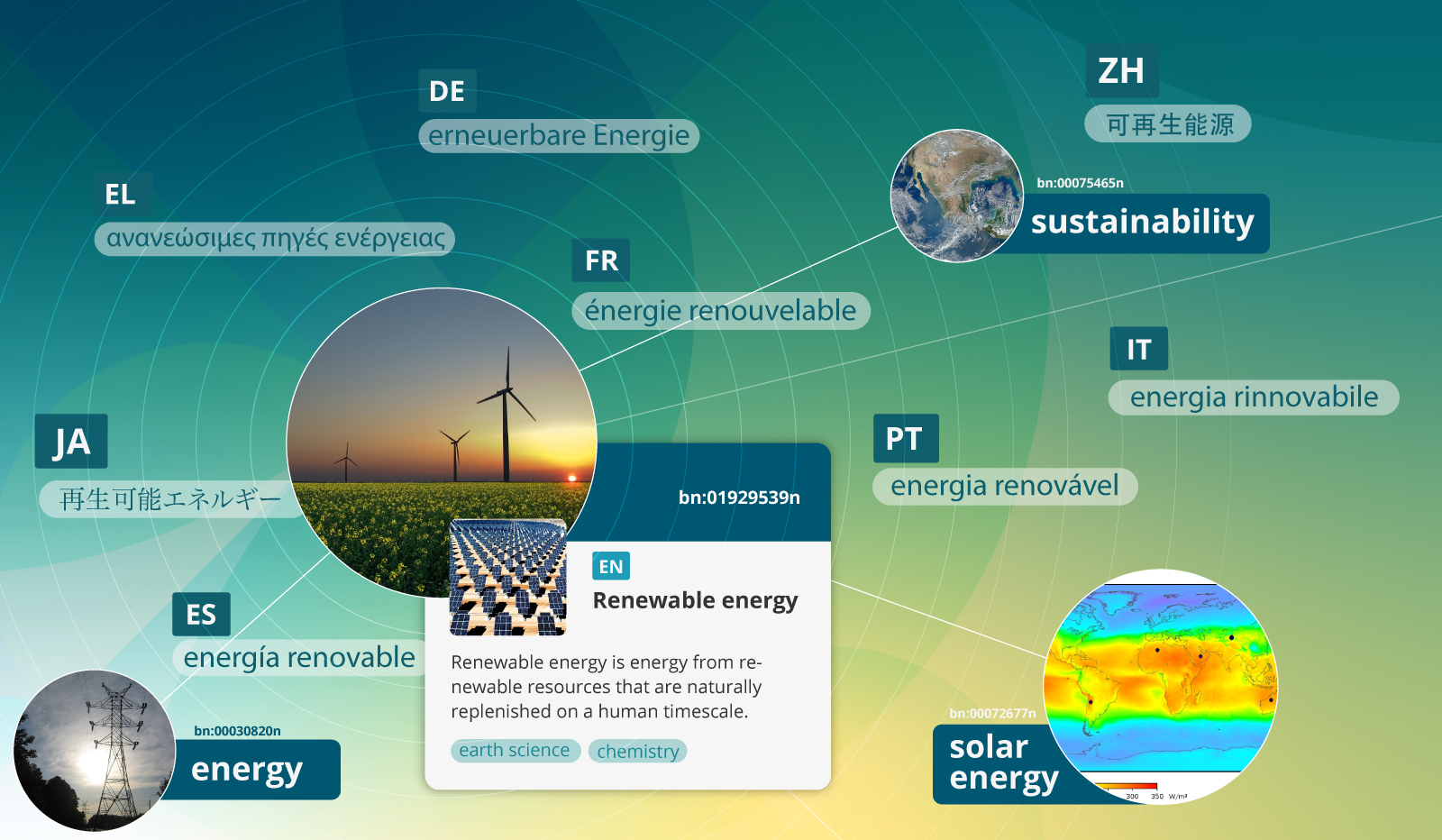
At its heart are Babel synsets. Each synset represents a concept or a named entity and groups the words and expressions that are used to denote it across languages. Definitions, images, and usage examples enrich every entry, while hundreds of semantic relations link each synset to other synsets, connecting individual meanings within one shared language-independent network.
A timeline of key milestones
The story began within the Sapienza NLP Group. In 2010, the ACL paper BabelNet: Building a Very Large Multilingual Semantic Network introduced a way to combine WordNet's structured lexical knowledge with Wikipedia's encyclopedic coverage, linking the two through shared meanings. A fuller account followed in 2012 in the journal Artificial Intelligence, describing how the network was built, evaluated and applied to multilingual word sense disambiguation, the task of identifying which meaning of a word is intended in context. That paper received the AI Journal's Prominent Paper Award in 2017.
With the support of the European Research Council through the MultiJEDI project, BabelNet then grew rapidly. Version 2.0 (2013) expanded coverage from the original six languages to 50, incorporating OmegaWiki and the Open Multilingual WordNet, and in 2014 the knowledge graph was published as Linked Data, as documented in the LREC paper Representing Multilingual Data as Linked Data: the Case of BabelNet 2.0. Version 3.0, released in December 2014, reached 271 languages and added pronunciations, usage examples and richer taxonomic connections.
Research soon explored how to put this shared inventory of meanings to use: the SemEval-2015 task on Multilingual All-Words Sense Disambiguation and Entity Linking relied on BabelNet to bring word interpretation and named entity identification into a single evaluation framework. Later releases added domain labels and further semantic relations, and version 4.0 (2018) reached 284 languages, strengthening resource alignment through manual validation.
Research also fed new resources into the network: VerbAtlas (2019) for verb meanings and semantic roles, and BabelPic (2020) for images of non-concrete concepts. BabelNet 5.0 (2021) linked to both and expanded to 500 languages and more than 20 million synsets, while the IJCAI survey Ten Years of BabelNet took stock of the knowledge graph and its applications. In 2022, the AAAI paper BabelNet Meaning Representation: A Fully Semantic Formalism to Overcome Language Barriers proposed a language-independent way of representing meaning, and the ACL paper Fully-Semantic Parsing and Generation: the BabelNet Meaning Representation showed how it supports multilingual parsing and generation.
Versions 5.1 and 5.2 continued to update resources and refine data quality. By version 5.3, released in December 2023, BabelNet covered 600 languages and nearly 23 million synsets, with improved cross-lingual mappings and refreshed lexical and encyclopedic sources.
The main versions at a glance:
| Version | Year | Languages | Highlights |
|---|---|---|---|
| 1.0 | 2010 | 6 | WordNet and Wikipedia linked through shared meanings |
| 2.0 | 2013 | 50 | Adds OmegaWiki and the Open Multilingual WordNet |
| 3.0 | 2014 | 271 | Pronunciations, usage examples, richer taxonomic connections |
| 4.0 | 2018 | 284 | Resource alignment strengthened by manual validation |
| 5.0 | 2021 | 500 | More than 20 million synsets; links to VerbAtlas and BabelPic |
| 5.3 | 2023 | 600 | Nearly 23 million synsets; improved cross-lingual mappings |
In 2026, the AAAI paper Is Word Sense Disambiguation Dead in the LLM Era? revisited the lexical-semantic task at the origin of this research: word sense disambiguation. It showed that semantics is far from dead: in the era of generative AI, beyond its role in grounding, it serves an additional purpose, evaluating and improving the lexical-semantic competence of large language models.
Today, and what comes next
Today, BabelNet is engineered and maintained by Babelscape. Its development continues the goal that shaped the original research: connecting knowledge across languages through meaning.
Now, the story continues. BabelNet 6 is on its way.